A LOCAL BUSINESS SERVING DUMFRIES AND GALLOWAY AND BEYOND
Direct dial 07432 675 810
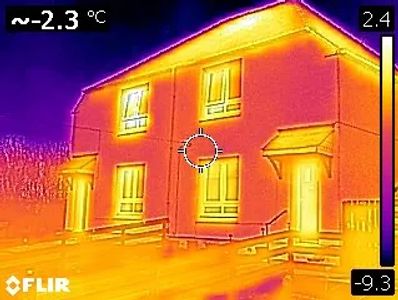
Thermal Imaging for Domestic Heat Loss
Most of us think of our homes as solid barriers against the elements. In reality, they are dynamic systems constantly exchanging energy with the outside world. Often, this exchange is an expensive, invisible leak. Thermal imaging (or infrared thermography) is the "superpower" that makes this invisible energy flow visible, providing a non-invasive map of exactly where your home—and your wallet—is losing heat.
What is Thermal Imaging?
Everything with a temperature above absolute zero emits infrared radiation. While the human eye is limited to the visible light spectrum, thermal imaging cameras use specialized sensors to detect this infrared energy.
The camera converts these heat signatures into a visual image called a thermogram. In a typical "ironbow" color palette:
* White and Yellow represent high temperatures (areas of high heat emission).
* Red and Orange represent moderate temperatures.
* Blue and Purple represent cold spots.
When used on a domestic property, the camera doesn't "see through" walls like an X-ray; rather, it measures the surface temperature of those walls, ceilings, and floors. By analyzing these temperature differentials, we can diagnose what is happening behind the plaster or under the floorboards.
Beneficial Properties in Heat Loss Detection
Using thermal imaging in a home isn't just about finding drafts; it’s about a comprehensive "health check" for the building's thermal envelope. Here is why it is an essential tool for homeowners:
1. Pinpointing "Ghost" Drafts (Air Leakage)
Traditional methods of finding drafts often involve feeling for moving air with your hand—a subjective and imprecise tactic. Thermal imaging reveals exactly where cold air is infiltrating. Common culprits include:
* Gaps in window frames and door seals.
* Unsealed lofts hatches.
* Service penetrations (where pipes or wires enter the home).
2. Identifying Missing or Failed Insulation
You might assume your walls are well-insulated because you paid for it years ago, but insulation can settle, sag, or be improperly installed. A thermal scan can show "cold spots" in a wall where insulation is missing or has become damp. It also detects thermal bridging—structural elements (like steel beams or concrete lintels) that act as "heat highways," conducting warmth straight out of the house.
3. Detecting Moisture and Damp
Wet insulation loses its thermal resistance almost entirely. Because water has a higher thermal mass than dry building materials, it changes temperature more slowly. This allows thermal cameras to spot damp patches—often before they are visible to the naked eye as mold or peeling paint—helping to prevent structural damage and respiratory issues.
4. Evaluating Heating System Efficiency
Thermal imaging is excellent for checking the health of your radiators or underfloor heating. A scan can reveal:
* Sludge buildup: Cold spots at the bottom of a radiator indicate a need for power-flushing.
* Underfloor leaks: Identifying the exact location of a leaking pipe without tearing up the entire floor.
Why It Matters: The Bottom Line
The primary benefit of thermal imaging is precision. Instead of a "scattergun" approach to home improvements—like replacing all your windows when the real issue is a lack of loft insulation—thermal imaging allows for targeted, cost-effective retrofitting.
Optimal Conditions for a Scan:
To get the most accurate results, there should be a significant temperature difference (usually at least 10°C) between the interior and exterior of the property. This is why professional scans are typically conducted during winter or in the early morning.
By identifying where heat is escaping, homeowners can significantly reduce their carbon footprint and slash energy bills, ensuring that the heat they pay for actually stays inside.

The image shows a section of the ceiling where insulation is missing.
This area would be particularly vulnerable to mould formation due to the condensation caused by temperature differences on the surfaces.
(Darker areas are colder)
Thermal imaging allows you to see hidden areas that would otherwise be missed.
A low cost alternative to invasive works.